
Acapella Extractor: Isolate the Vocals From Your Song

With a Google sign-in, upload an MP3 or WAV and let the AI pull the vocals out as their own track. Listen for bleed and reverb, then download the vocals as WAV.

Free with Google sign-in: 10 minutes of processing per calendar month. MP3 or WAV, up to 30 MB and 5 minutes. Processed in the cloud.

VOCAL & INSTRUMENTAL SEPARATORONLINE AI SEPARATION

Start with a song

Choose an MP3 or WAV to separate into two tracks.

MP3 / WAV · 30 MB max · 0.5 seconds–5 minutes
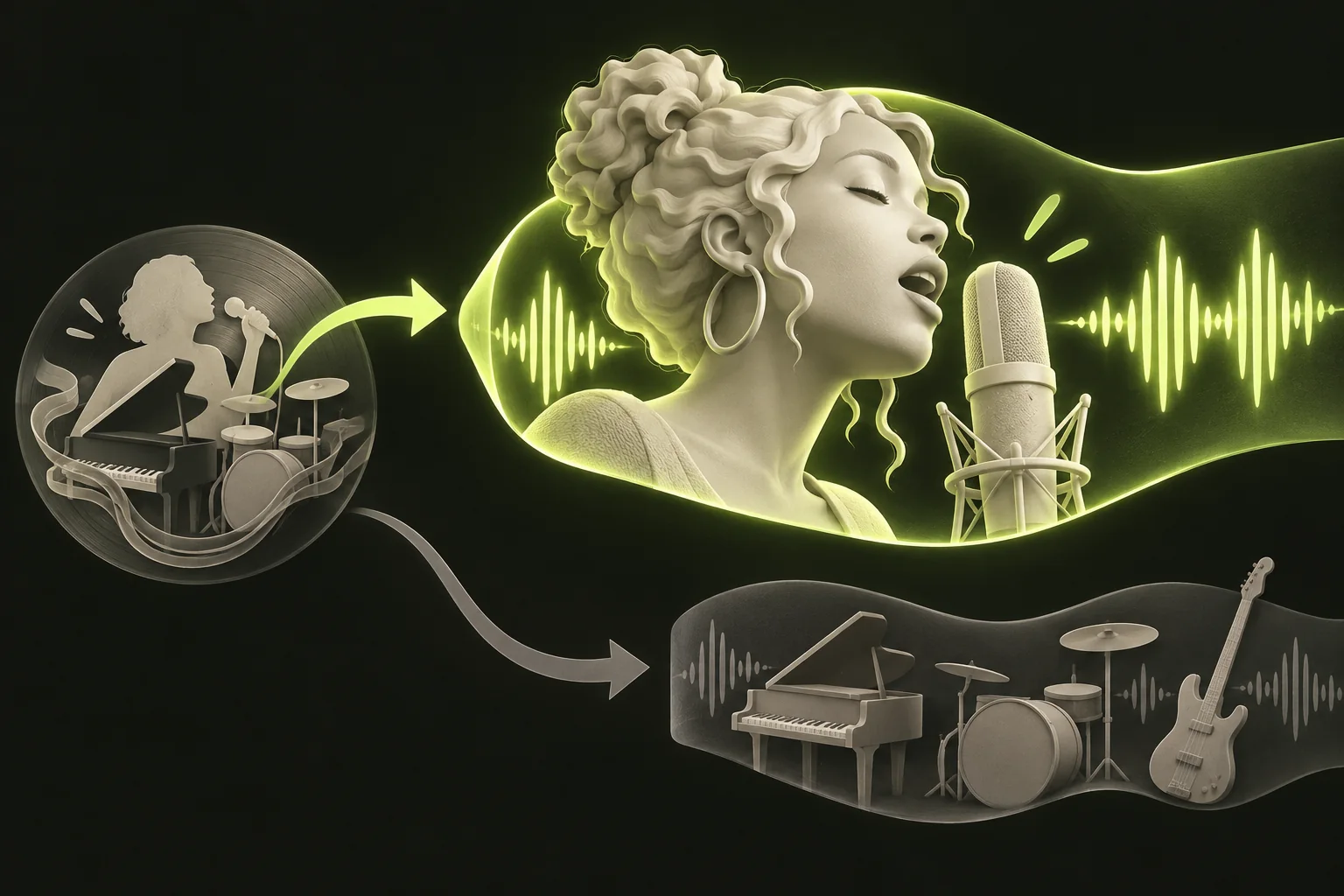
Vocals and accompaniment are separated by cloud AI.Preview and download both tracks separately.

Example: Take the voice into a remix

A microphone and singer are emphasized in the vocal output, while the instrumental output remains a separate, quieter bundle.
Task illustration, not a vocal-quality demonstration.

Choose Vocals first and check the voice before editing.

  1. Mixed song
  2. Listen to Vocals
  3. Edit with permission

Free acapella extractor conditions

Here’s what applies before you choose a song.

  • Sign-in and allowance: You need a Google sign-in. A free account gets 600 seconds (10 minutes) of processing per calendar month, counted across all your files. It isn’t unlimited, and the month follows UTC.
  • What uses your time: Processing time is reserved using the audio’s duration, rounded up to the next whole second. It is based on audio length, not how long separation takes.
  • Accepted files: MP3 or WAV, up to 30 MB, between 0.5 seconds and 5 minutes long.
  • Where it runs: Online, in the cloud. Your file is uploaded for separation.
  • What comes back: A Vocals track, which is the one you’re here for, plus an Instrumental track with everything else. Both download as WAV.
  • How long you have: 24 hours on a free account after processing finishes.

New cloud tasks keep results for 24 hours on Free, 7 days on Pro, or 30 days on Studio. The expiry shown with each task stays fixed when you open it or change plans. Reusing the same available result does not use more minutes.

How to isolate vocals from a song

Five steps to the vocals: Google sign-in; Choose MP3 / WAV; Wait for two tracks; Listen: Vocals first; Download vocal WAV
Five steps to the vocalsIllustrates the optional sign-in-first route. You can also choose a file first and sign in at Start. This is a workflow illustration, not a measured result.

Start with an MP3 or WAV you own or have permission to work with. Then follow five steps.

  1. Choose your MP3 or WAV. Pick a file you have permission to edit that fits the limits above.
  2. Click Start separation. Sign in with Google if needed, then return here and start when you are ready.
  3. Start the separation and wait. The AI estimates the voice and the music as two separate tracks. Wait until the results appear.
  4. Listen to the vocals first. Play a passage of the original, then the same passage on the Vocals track.
  5. Download the vocals. Save the Vocals track as a WAV file. The Instrumental track has its own download if you need it.

Compare the original mix and the extracted vocals

An acapella can sound fine on a quick listen and still fall apart in a remix, so check it closely before you build on it. Play your original in your usual audio player and the Vocals track in StemNook, at the same moments.

A vocal listening check

  1. Pick a busy passage and a quiet one. A full chorus and a sparse verse show different problems. For a clip shorter than 20 seconds, listen to the whole thing.
  2. Listen to the consonants. S, T and K sounds should stay crisp. A lisping, smeared or splashy edge is a common separation artifact.
  3. Listen to the ends of lines. Do held notes and word endings stop too early, or does an echo trail on after the voice?
  4. Listen behind the voice. Drum hits, cymbals, bass notes or guitar can leak through. Listen for a thin, metallic or watery tone too.
  5. Check the Instrumental track. If you can hear singing in it, some of the voice stayed with the music, and the Vocals track may be thinner there.

How to use the illustrated task example

The illustration near the top shows the task of taking Vocals into an authorized remix. It highlights the voice, while the combined instrumental remains a separate output. It is a conceptual workflow, not a sample of a song processed by StemNook. Judge your own result by listening for instrument bleed, consonants and reverb tails.

If the vocals aren’t usable

Try a different version of the song if you have one. A mix with less reverb or fewer instruments behind the voice gives the separation less to untangle. You can also use only the sections that came out cleanly.

MP3 and WAV inputs and vocal downloads

A vocal WAV is manually taken from a two-track result into a separate editing workspace.
Save the vocal as WAVOpen the downloaded vocal in another editor.

The extractor accepts MP3 and WAV files only. Video files, other audio formats and web links aren’t accepted.

Both results download as WAV at 44.1 kHz, 16-bit, stereo. There’s no MP3 download, so if a project needs MP3, convert the WAV with another tool.

An estimate, not the studio vocal

The Vocals track is the AI’s estimate of the voice in a finished mix. It isn’t the original studio vocal recording, and WAV output doesn’t make it lossless or keep your file’s original encoding.

File sizes

A WAV at 44.1 kHz, 16-bit stereo takes about 10.6 MB per minute, so the vocals from a three-minute song come to about 32 MB. On upload, a WAV of that kind passes 30 MB at just under three minutes, so an MP3 copy of a longer song is the easier way to stay within the limit.

Vocals for practice and authorized remixing

An isolated vocal lets you hear the singing without the band covering it.

A listener with headphones follows the phrasing of a vocal track beside a blank study notebook.
Listen to phrasingHear breaths, timing and pronunciation.
  • Learn a vocal part. Hear phrasing, breaths and harmonies more clearly than in the full mix.
  • Study pronunciation. Follow the words of a song in another language at the speed they’re sung.
A person takes a vocal from their own microphone recording into a separate music editing project.
Work with permitted recordingsUse your own voice or audio you may edit.
  • Authorized remixes and edits. Use vocals from your own recordings, or from tracks you have permission to remix.
  • Sampling with permission. Lift a vocal phrase for a project when you have the rights to use it.

Extracting vocals doesn’t change who owns a recording. Use only audio you own or have permission to work with, and check the rules before you publish, sell or perform anything built on it. This isn’t legal advice.

Bleed, reverb and metallic artifacts

Listen beyond the melody: Consonants: S / T / K; Line endings and reverb; Instrument bleed behind voice; Metallic or watery tone
Listen beyond the melodyUse these checks with your own permitted audio.

AI separation guesses which parts of a finished mix belong to the voice. Results vary from song to song, and the Vocals track can carry traces of other sounds.

A vocal ribbon includes a faint drum trace and echo rings, illustrating possible bleed and reverb.
Check bleed and echoListen for instruments and trailing reverb.

What you might hear in the vocals

  • Instrument bleed: drum hits, cymbals, bass or guitar faintly behind the voice.
  • Reverb and echo: reverb added to the voice in the original mix often comes along with it, so the track may not be dry.
  • Smeared consonants: S and T sounds that turn soft, splashy or lisping.
  • Metallic tone: a thin, ringing or watery edge, often on long notes.
  • Gaps: moments where a loud instrument masked the voice and the vocal drops out or thins.

What this tool doesn’t do

  • It returns the vocals as one track, without separating lead and backing vocals.
  • It doesn’t remove reverb, clean up noise or make the vocal dry.
  • It can’t recover the original studio recording or produce drum, bass or other instrument tracks.

Cloud processing and access

Separation happens in the cloud, so your file is uploaded. Free-account results are available for 24 hours after processing finishes, so download the vocals you want to keep before then.

Acapella extractor troubleshooting

Match what you see to the right fix.

  • The file is rejected. It must be an MP3 or WAV between 0.5 seconds and 5 minutes and no larger than 30 MB. Long WAV files hit the size limit first.
  • You can’t sign in. Separation needs a Google account. Sign in again, then pick your file again if the page asks for it.
  • A message says you need more processing time. “This file needs more processing time than you have left this month” means this file is longer than what’s left, even if some time remains. Use a shorter file or wait for the next calendar month.
  • Progress stops updating. That can be a connection problem rather than a failed separation. Wait, then check again before starting another one, because a new separation may use more of your monthly time.
  • The separation failed. Follow the error message and check any file limit it identifies. Before another attempt, check the current task and your remaining allowance. A new attempt may reserve processing time.
  • The results are no longer available here. Check whether you already downloaded them. If you need to separate the original again, the new task may use your monthly allowance.

Acapella extractor questions

Is this a free AI acapella extractor?

Yes, within a limit. You sign in with Google, and each free account gets 600 seconds (10 minutes) of processing per calendar month, shared across all your files.

Why can I still hear instruments in the vocals?

The AI estimates the voice from a finished mix, and sounds that share its frequencies, like cymbals or guitar, can leak through. Dense, loud arrangements tend to leave more behind. Try another version of the song, or use the cleaner sections.

Can it separate lead vocals from backing vocals?

No. All the singing comes out together on one Vocals track, and some harmonies may end up partly in the Instrumental track instead.

Will the vocals be dry, without reverb?

Not necessarily. Reverb and echo that were part of the voice in the original mix often stay with it, and the tool doesn’t remove them.

Can I download the acapella as an MP3?

No. The Vocals track downloads as a WAV file. Convert it with another tool if you need MP3.

Why was my file refused when I still have free time?

Check the message shown. If it says this file needs more processing time than you have left, its duration rounded up to whole seconds exceeds your remaining allowance. An exactly 3-minute file reserves 180 seconds, so 120 seconds left is not enough. Format, size, duration and sign-in messages need their own checks.

What should I do if the progress stops updating?

Wait a moment and check the same separation again before starting a new one. A connection problem can interrupt the progress display while the separation may still be running, and starting over may use more of your monthly time.

What’s the difference between extracting vocals and removing them?

It’s the same separation with a different goal. An acapella extractor is for the Vocals track; a vocal remover is for the Instrumental track. Here, the vocals come first, and the Instrumental track is there if you need it.

Can I use an extracted acapella in a remix I publish?

Only with the rights to do so. Extracting the vocals doesn’t give you permission to use them. Check with the rights holder before you publish or sell anything. This isn’t legal advice.